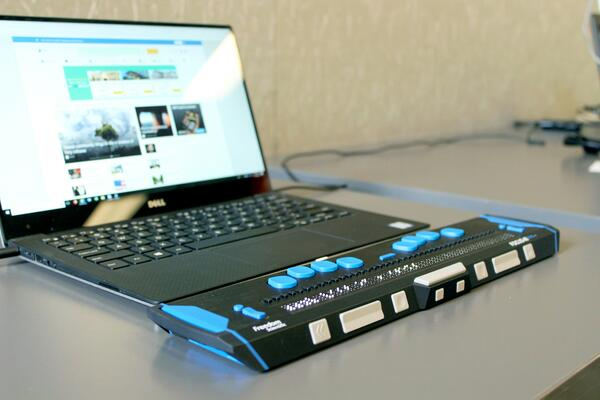
Laptop connected to a brallie display device with tactile buttons and refreshable braille cells for visually impaired users working on digital content.

What Is Braille and Why Does It Still Matter in 2026?

In a world powered by voice assistants, screen readers, and artificial intelligence, you might wonder whether Braille still holds a place in the lives of blind and visually impaired individuals. The answer, without hesitation, is yes — and in 2026, Braille in Jacksonville is more relevant than ever. Braille is not a relic of the past. It is a living, evolving system of literacy that empowers blind and low-vision individuals to read, write, learn, and live with confidence and independence. For the Jacksonville community, understanding Braille is not just an academic exercise — it is a gateway to inclusion, advocacy, and a deeper appreciation of what it means to make our city truly accessible for everyone.

The Jacksonville Council of the Blind is proud to champion Braille literacy as a core pillar of its mission. From supporting newly diagnosed individuals to connecting longtime community members with the latest Braille technology, JCB stands at the intersection of education, empowerment, and advocacy. This article explores what Braille is, the history behind it, why it remains indispensable in modern life, and how Jacksonville residents can access Braille resources right in their own community.

What Is Braille? Understanding the System and Its Origins

The Braille System: How Raised Dots Became a Language of Literacy

Braille is a tactile reading and writing system that allows blind and visually impaired individuals to access written information through touch. It is critically important to understand that Braille is not a language in itself — it is a code, a method of representing letters, numbers, punctuation, and even musical notation through a precise arrangement of raised dots. Each Braille character is formed within a rectangular unit called a Braille cell, which contains up to six raised dots arranged in two columns of three. The specific combination of raised and flat dots within that cell determines what letter, number, or symbol is being communicated. There are 63 unique dot combinations possible within a single Braille cell, which means the system is rich enough to represent the full complexity of written language. A reader moves their fingertips from left to right across the raised dots, decoding information in real time through touch rather than sight. Braille can be produced on embossed paper, displayed on refreshable Braille displays connected to computers and smartphones, or read through Braille eBooks and digital readers. For blind and low-vision individuals in Jacksonville and across the country, Braille is not merely a convenience — it is a foundational literacy tool that opens doors to education, employment, and independent living.

Beyond the standard literary Braille used for everyday reading and writing, the system has been adapted into specialized codes that serve specific disciplines and fields of knowledge. Nemeth Braille, for example, is designed specifically for mathematics and general science, providing symbols for complex equations and formulas that standard literary Braille cannot represent. Music Braille allows blind musicians and music lovers to read and write musical notation, including notes, rhythms, and dynamic markings, making the world of music fully accessible without the need for sighted assistance. Computer Braille Code, developed by the Braille Authority of North America, represents computer-related symbols and commands, which is invaluable in today’s technology-driven workplace. These specialized codes reflect the remarkable adaptability of the Braille system and demonstrate why it continues to grow and evolve rather than fade into obsolescence. In Jacksonville, blind and visually impaired individuals who use these specialized Braille codes can fully participate in careers in STEM, music, technology, and countless other fields. The Jacksonville Council of the Blind actively works to ensure that community members are aware of these tools and have access to the training and resources they need to use them effectively. Braille, in all its forms, is a living system — one that continues to grow alongside the communities it serves.

Louis Braille: The Remarkable Story Behind the System

The story of Braille begins with a young French boy named Louis Braille, who lost his sight in a childhood accident at just three years old. Despite his blindness, Louis was fortunate to receive a formal education, though the tools available to blind students at the time were limited and often inaccessible. At the age of 12, Louis encountered a military communication system invented by Charles Barbier de la Serre — a complex phonetic code based on 12 raised dots that soldiers used to read messages in the dark without making a sound. Louis immediately recognized the potential of a tactile reading system but also saw its flaws: Barbier’s system was too complex and too slow for practical everyday use. Over the next several years, Louis refined and simplified the system, reducing the 12 dots to just 6 and developing a far more logical, efficient, and readable code. By 1824, when Louis was just 15 years old, he had completed the foundational version of what would eventually become the global Braille system we know today. He spent the rest of his life continuing to refine and expand the system, incorporating musical notation and mathematical symbols to make it as comprehensive as possible. Louis Braille’s legacy is celebrated every year on January 4th — World Braille Day — and throughout the month of January as National Braille Literacy Month, both of which the Jacksonville Council of the Blind honors as opportunities to raise awareness and celebrate the Braille community.

Louis Braille’s contribution to the world cannot be overstated. Before his system was developed and adopted, blind individuals had few reliable ways to access written information independently, and the concept of literacy for the blind was often treated as an afterthought by educational institutions and governments alike. The Braille system fundamentally changed that reality, establishing that blind individuals are just as capable of learning, reading, writing, and contributing to society as their sighted peers — they simply need the right tools to do so. Today, the United States uses the Unified English Braille (UEB) standard, which was adopted in 2016 and is also used across several other English-speaking countries around the world, ensuring consistency and interoperability in Braille education and materials. In Jacksonville, Braille literacy has deep roots through institutions like the Florida School for the Deaf and the Blind and local organizations including the Jacksonville Council of the Blind, which actively promotes Braille education and access for residents of all ages. Honoring Louis Braille means more than remembering a historical figure — it means committing to the ongoing work of making Braille resources available, affordable, and accessible to every blind and low-vision individual in our community. The Jacksonville Council of the Blind carries that commitment forward every single day.

Did You Know? World Braille Day is celebrated every January 4th — the birthday of Louis Braille. National Braille Literacy Month is observed throughout January. The Jacksonville Council of the Blind honors both as opportunities to celebrate and expand Braille literacy in Northeast Florida.

Why Braille in Jacksonville Still Matters in 2026

Braille and Literacy: Why Audio Alone Is Not Enough

One of the most common misconceptions about Braille in the modern era is the assumption that audio technology — screen readers, voice assistants, and audiobooks — has made Braille unnecessary. This could not be further from the truth, and research consistently confirms it. Braille is to blind individuals what print literacy is to sighted individuals: it teaches spelling, grammar, punctuation, and sentence structure in ways that listening alone simply cannot replicate. A child who learns exclusively through audio may develop strong listening comprehension but can fall behind in spelling, writing, and the structural understanding of language that is essential for academic and professional success. Studies have consistently shown that Braille readers achieve higher levels of education, are more likely to be employed, and report greater independence and confidence than blind individuals who rely solely on audio. The tactile process of reading Braille — decoding letters and symbols with the fingertips — promotes active cognitive engagement and deeper interaction with written content in a way that passively listening to audio does not. For children in Jacksonville who are blind or have low vision, early Braille instruction is not just beneficial — it is essential for building the literacy foundation they will rely on throughout their entire lives. The Jacksonville Council of the Blind strongly advocates for robust Braille education in Jacksonville’s schools and rehabilitation programs as a matter of equity and opportunity.

Braille also provides something that audio technology fundamentally cannot: privacy. Reading a personal bank statement, a medical document, or a private message through a screen reader means hearing that information spoken aloud — which is not always appropriate or desirable in public or shared spaces. Braille, by contrast, is entirely silent and private, allowing blind individuals to access sensitive information with the same discretion that sighted people take for granted. This aspect of Braille is often overlooked in conversations about accessibility but represents a meaningful dimension of dignity and independence for those who use it. Beyond privacy, Braille allows blind individuals to label and organize their personal belongings — from medication bottles and food cans to file folders and kitchen items — without relying on anyone else for assistance. In Jacksonville, where the blind and visually impaired population spans all ages and backgrounds, Braille serves as a great equalizer, giving people of every income level and ability a reliable, low-cost path to independence. The Jacksonville Council of the Blind provides members with information on how to access Braille labeling tools, Braille displays, and Braille instruction resources so that every community member can take full advantage of what this remarkable system offers. Braille is not a backup option for when technology fails — it is a primary literacy tool that stands on its own merits in 2026 and beyond.

Braille and Modern Technology: A Powerful Partnership

Far from being in conflict with modern technology, Braille has evolved alongside it in ways that make both more powerful together. Refreshable Braille displays — electronic devices that translate digital text into raised Braille dots in real time — can be connected to computers, smartphones, and tablets, allowing blind users to read emails, browse websites, write documents, and access apps through touch rather than audio. This combination of Braille literacy and digital technology gives blind users a level of precision, speed, and independence that neither tool could provide alone. Smart Braille watches now allow users to check the time, receive notifications, and read short messages discreetly on their wrist, blending the tactile familiarity of Braille with the convenience of wearable technology. BrailleType systems enable blind users to type Braille directly onto touchscreen devices, removing the need for specialized hardware and making Braille input accessible on everyday smartphones. In Jacksonville, blind professionals who work in technology, business, healthcare, and education rely on these Braille-integrated tools to perform their jobs at the same level as their sighted colleagues. The Jacksonville Council of the Blind stays current with these developments and works to connect members with the latest assistive technology resources, training opportunities, and funding options for acquiring Braille devices. Embracing Braille technology is not about living in the past — it is about harnessing every available tool to live fully and independently in the present.

The partnership between Braille and technology also extends into public spaces throughout Jacksonville and across Florida. The Americans with Disabilities Act requires Braille signage in buildings open to the public — including elevators, restrooms, room numbers, and exit signs — meaning that Braille literacy directly enhances a person’s ability to navigate public environments independently and safely. ATMs across Jacksonville feature Braille keypads, allowing blind users to conduct financial transactions privately without assistance. Restaurant menus, prescription labels, and transit information are increasingly available in Braille formats as businesses and institutions recognize their legal and moral obligations to accessibility. For blind and visually impaired Jacksonville residents, the ability to read Braille transforms these public accommodations from theoretical amenities into practical, usable tools for daily life. When a person cannot read Braille, all of these accessibility features become meaningless — which is precisely why Braille literacy advocacy matters so deeply to organizations like the Jacksonville Council of the Blind. Every elevator panel, every ATM, and every accessible menu is an argument for Braille education. In a city as vibrant and growing as Jacksonville, ensuring that its blind and visually impaired residents can independently access public spaces is not just a legal requirement — it is a reflection of our community’s values.

Braille Resources and Support in Jacksonville, Florida

Where to Learn Braille in Jacksonville and Across Florida

For Jacksonville residents who are blind, visually impaired, or who have a loved one navigating vision loss, accessing quality Braille instruction is more achievable than many people realize. The Florida Division of Blind Services (DBS) provides vocational rehabilitation and independent living services for blind and visually impaired Floridians, including access to Braille instruction for adults who are entering or re-entering the workforce. Children in Jacksonville’s public school system who are blind or have low vision are entitled under federal law to Braille instruction as part of their Individualized Education Program (IEP), provided there is not a specific documented reason why another literacy medium is more appropriate for that child. The Florida School for the Deaf and the Blind, located in St. Augustine just a short drive from Jacksonville, offers comprehensive Braille education for students from kindergarten through high school in a specialized environment designed specifically for blind and deaf learners. The Talking Book Library, a service of the Florida Division of Library and Information Services, provides free audio and Braille books to Floridians with visual or physical impairments, making Braille reading material widely accessible to Jacksonville residents at no cost. Online resources such as Paths to Literacy and Unified English Braille Online provide free workshops, tutorials, and training programs for people of all ages who want to learn Braille or who support someone learning it. The Jacksonville Council of the Blind serves as a connector, helping members navigate these resources and find the right instruction pathway for their specific needs and goals. No Jacksonville resident should have to search alone for Braille education — the Council is here to guide every step of that journey.

Learning Braille as an adult — particularly after acquiring a vision impairment later in life — can feel daunting, but it is absolutely achievable and deeply worthwhile. Research has shown that with consistent instruction and practice, adults can develop functional Braille reading skills that significantly enhance their independence and quality of life. Like any new skill, Braille requires time, patience, and the right support system, but the rewards are immeasurable. Many adults who learn Braille later in life report that it transforms their sense of self-sufficiency — enabling them to read independently, label their belongings, navigate public spaces, and engage with written information on their own terms for the first time since losing their sight. The Jacksonville Council of the Blind offers peer mentorship through members who have personal experience learning Braille as adults, providing encouragement and practical guidance that no textbook can replicate. Misconceptions about Braille — such as the idea that it is too slow, too hard, or only for children — continue to discourage adults from pursuing it, and the Council actively works to dismantle these barriers through education and community outreach. In Jacksonville, Braille instruction is available for residents of all ages, backgrounds, and levels of vision loss, and the Council is committed to ensuring that every person who wants to learn Braille has a clear and supported path to do so.

How the Jacksonville Council of the Blind Advances Braille Literacy Locally

The Jacksonville Council of the Blind has long recognized Braille literacy as a cornerstone of independence, dignity, and full community participation for blind and visually impaired residents of Northeast Florida. As a proud affiliate of the Florida Council of the Blind and the American Council of the Blind, JCB brings the collective advocacy power of these national organizations to the local level, pushing for stronger Braille education standards, greater availability of Braille materials in public spaces, and increased funding for assistive technology programs that support Braille users. At monthly membership meetings — held on the third Monday of each month at Brooks Clubhouse in Jacksonville — members share information about Braille resources, assistive technology developments, and local and state policy changes that affect the blind community. These meetings are accessible in person and via Zoom, ensuring that every member of the Jacksonville blind community can participate regardless of transportation or mobility limitations. JCB also collaborates with the Florida Division of Blind Services, the Talking Book Library, and local schools to advocate for expanded Braille instruction and materials across Jacksonville. Through outreach in accessible formats — including audio, Braille, and large-print communications — the Council ensures that information about Braille resources reaches blind and visually impaired Jacksonville residents through channels they can actually access. The Council’s work on Braille advocacy is not just about promoting a reading system — it is about protecting the right of every blind person in Jacksonville to be fully literate, fully informed, and fully included in community life.

Braille literacy is not a niche concern — it is a civil rights issue. When blind children do not receive adequate Braille instruction, they enter adulthood without the literacy foundation they need to compete educationally and professionally. When Braille signage in public buildings is missing or incorrect, blind Jacksonville residents are denied the independent access to public spaces that their sighted neighbors enjoy without a second thought. When adults who acquire vision loss are not connected to Braille instruction and assistive technology resources, they lose independence that can be preserved with the right support. The Jacksonville Council of the Blind fights on all of these fronts simultaneously — advocating in schools, in city halls, in the Florida Legislature, and in the U.S. Congress for policies and funding that make Braille literacy a reality for every blind Floridian who wants it. Community members, family members, educators, employers, and advocates are all welcome to join the Council and add their voices to this important work. Together, we can build a Jacksonville where every blind resident has access to Braille education, Braille technology, and a community that understands and values their right to full literacy and independence. The Jacksonville Council of the Blind invites you to be part of that mission — starting today.

The owner of this website has made a commitment to accessibility and inclusion, please report any problems that you encounter using the contact form on this website. This site uses the WP ADA Compliance Check plugin to enhance accessibility.