
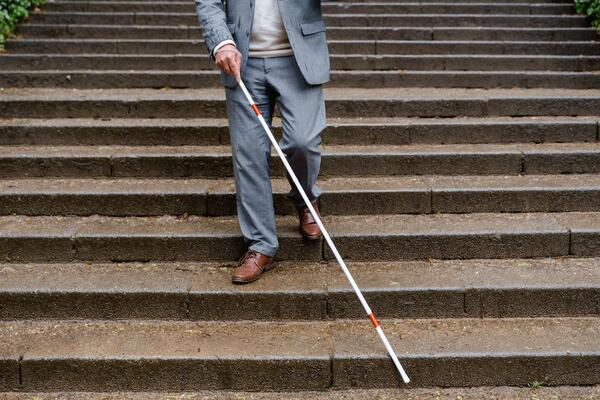
The first time someone rolls through a crosswalk while you’re standing there with your cane raised, you learn something fast.
Most drivers don’t know the law exists.
That’s not your fault. And it’s not something you should have to explain while standing in the middle of a street. But knowing exactly what Florida’s white cane law says — and just as importantly, what it doesn’t — puts something real in your hands the next time it happens. Not just frustration. Information. And information you can actually use.
This post breaks down the statute in plain language, tells you where to get cane training if you’re just starting out, and explains why a single day in October matters more than most people realize.
What Florida’s White Cane Law Actually Says
Florida Statute 316.1301 has three parts. Most people only hear about the second one. Here’s all three.
What drivers are required to do
If you’re crossing or about to cross a street while using a white cane or a guide dog, every approaching driver must come to a full stop before reaching the intersection or crossing point. Not slow down. Not yield when convenient. Stop. They stay stopped until you’ve cleared the roadway. A violation is a moving violation under Chapter 318 — same category as running a stop sign or failing to yield. It carries real penalties. It’s a traffic law, not a suggestion.
Most drivers who don’t stop aren’t being malicious. They genuinely don’t know. That’s a public awareness problem, not a legal one. The law is clear. The enforcement is the gap.
The section nobody mentions
Section one of the statute makes it a second-degree misdemeanor for anyone who is not blind or visually impaired to carry a raised white cane in public. That sounds strange until you understand why it’s there. If sighted people could wave white canes around, drivers would stop taking them seriously. The law protects the signal itself. When a driver sees a white cane or a red-tipped stick, it means one specific thing. No ambiguity, no confusion about whether the person holding it actually needs to be there.
The part that matters most in practice
Section three is the one that changes things. It says that not carrying a cane or not using a guide dog does not take away your rights as a pedestrian, and it cannot be used against you in court as comparative negligence. In plain language: if you get hit crossing the street without a cane, the driver’s lawyer cannot argue it was partly your fault for not looking blind enough. The law protects you whether you carry a cane or not. Some people choose not to use a cane for reasons that are nobody else’s business, and the law says explicitly that choice doesn’t reduce your rights.

| Full statute text For the complete Florida Statute 316.1301, visit the City of Jacksonville’s White-Cane Law page or search the Florida Legislature’s online statutes at leg.state.fl.us. |
Cane Training: What It Is and How to Get It
Knowing the law is one thing. Moving through the world with the cane confidently is a completely different skill, and it doesn’t come from reading about it.
Why training changes everything
A white cane is not a magic wand. It’s a tool, and like any tool, using it well takes actual instruction. Orientation and mobility specialists teach you how to detect drop-offs at curbs, navigate stairs, find doorways, cross streets safely, and move through crowds without the cane getting tangled. Most people who pick up a cane without training use it like a probe, tapping straight ahead, and miss the arcs and sweeps that give you a full picture of what’s around you. The difference between tapping and sweeping is the difference between catching a curb and not catching it.
An O&M specialist meets you where you are, literally. They come to your home, your workplace, wherever you actually need to navigate. The first session is not a test. It’s an assessment of your vision, your goals, your environment. They ask where you want to go independently. The bus stop. The grocery store. Your doctor’s office. From there they build a plan around your actual life, not a generic curriculum someone wrote in an office. Sessions typically happen once or twice a week. Most people get the fundamentals within a few months. The goal is not perfection. It’s confidence. You learn to trust the feedback in your hand the way a sighted person trusts peripheral vision. That takes time, and it’s worth every minute of it.
Where to get O&M training in Florida
| City | Provider | What They Offer |
| Jacksonville | DBS District Office — (904) 992-2044 | Free O&M training for qualifying Floridians |
| Jacksonville | Brooks Clubhouse — JCB Monthly Meetings | Peer support, cane demos, Q&A with experienced users |
| Tampa/St. Pete | Lighthouse for the Blind | Orientation & mobility, white cane instruction |
| Orlando | Lighthouse Central Florida | Cane travel, low vision mobility |
| Miami | Miami Lighthouse | O&M training, white cane programs |
| Daytona Beach | DBS Rehabilitation Center | Residential O&M training program |
| Florida Division of Blind Services — Jacksonville District Phone: (904) 992-2044 • dbs.fldoe.org O&M training provided at no cost to qualifying Florida residents. |
Don’t overthink the call. If you’re considering cane training, make the appointment. If you’re not sure you’re ready, make it anyway. The first session is an assessment, not a commitment. You can always change your mind after you’ve actually seen what it involves.
White Cane Safety Day and What It Actually Accomplishes
Where it came from and why it still matters
Every October 15 is White Cane Safety Day. It has been recognized since 1964, when President Lyndon Johnson signed the first proclamation. The purpose has not changed: to celebrate the achievements of blind and visually impaired people and to raise awareness of the white cane as a tool of independence, not a symbol of limitation.
In Jacksonville, the Lions Club and local organizations often hold events around that date. Cane walks, informational tables, community gatherings. It sounds like a small thing until you think about what it actually does. When the local news covers White Cane Safety Day, drivers hear about the law. Some of them for the first time. Public awareness is not glamorous advocacy work, but it is the kind that changes what happens at crosswalks. That’s as practical as it gets.
The cane is a choice, not a requirement
A white cane is a signal, but it’s also a personal decision. Some people use one every day and some don’t. Others use a cane for certain routes and a guide dog for others. Some switch depending on the day or the environment. All of those choices are valid, and as Section three of the statute makes clear, all of them are protected by Florida law whether the cane is in your hand or sitting in your closet.
The statute gives you rights. The training gives you skill. The day on the calendar gives you visibility in the community. But what actually gives you the confidence to walk out your front door every morning is not any one of those things alone. It’s the combination, built slowly, one route at a time, until the route stops feeling like a challenge and starts feeling like yours.
One Last Thing
If you’ve been thinking about learning to use a white cane, or if you just want to understand your rights better before the next time someone rolls through a crosswalk while you’re standing in it, start with the people who’ve already walked this road. Our Vice President Barbara Brown explains what the means to her in this YouTube Video
Come to a JCB meeting and talk to members who use canes every day. Ask about the drivers who stop and the ones who don’t. Ask about how long it took before moving with the cane stopped feeling like work and started feeling like just moving. That kind of firsthand knowledge is different from anything you’ll read on a screen, including this.
The door is open.
Jacksonville Council of the Blind
Monthly meetings third Monday, 5:00–6:30 PM. Ask questions. Meet people. Find your people.
Brooks Clubhouse • 2700 University Blvd. West, Building 2, Jacksonville, FL 32217
(904) 674-6400 • JCBofJax@gmail.com • jcbjax.org
Cane training, support groups, and local resources: jcbjax.org/resources/
Zoom always available. Reach out through jcbjax.org/contact/ for the link.