
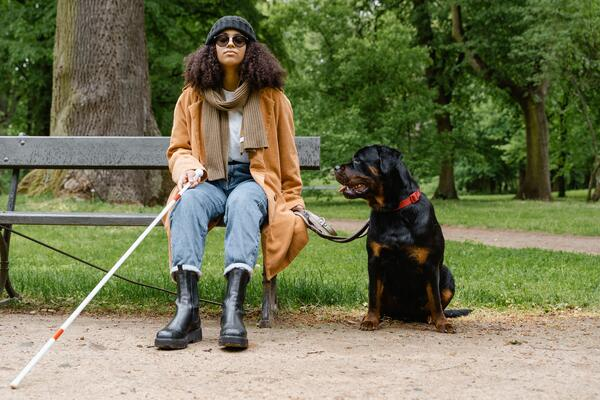
Blind & visually impaired individuals considering a guide dog
A lot of people wonder about guide dogs the same way.
They picture the yellow Lab walking a city crosswalk, steady and sure, navigating around a construction barrier without breaking stride. They wonder if that could be them. Then the wondering shifts. Am I ready for that? Am I blind enough? Can I afford it? Would it actually change anything?
Those are the right questions. And the honest answer to the first one is: maybe. A guide dog isn’t for everyone, and choosing not to get one doesn’t mean you’ve given up on anything. It means you assessed your life honestly and made a decision that fit it. But for the right person at the right time, a guide dog opens up a kind of freedom that a white cane alone can’t replicate. Not better than a cane. Different. This post is about helping you figure out which side of that line you’re on, and if you decide you want a dog, exactly what getting one actually looks like.
What a Guide Dog Actually Does
How the partnership works
Let’s clear up the biggest misconception first, because it shapes everything else. A guide dog does not lead you. You lead the dog. You give the direction commands. You decide where you’re going. The dog’s job is to handle the hazards along the way: navigate around obstacles, stop at curbs and stairs, duck under things at head height, and stay focused when there are distractions everywhere. Think of it less like a GPS and more like a co-pilot who handles the moment-to-moment road conditions while you handle navigation.
That distinction matters because a lot of people assume getting a guide dog means handing over control of how they move through the world. It’s actually the opposite. A guide dog extends your reach. It gives you information about the environment faster and more continuously than a cane can, which translates to a different quality of movement. More fluid. Less scanning. Less counting. That’s what people mean when they talk about the flow of working with a dog.
What a guide dog won’t do
A guide dog won’t read traffic lights. It won’t decide when it’s safe to cross a street. It won’t find a specific address, protect you from people, or function as any kind of alarm system. Those are movie inventions. A guide dog is a mobility tool, an extraordinary one, but a tool. The handler still needs solid orientation and mobility skills, which is why most guide dog schools require O&M training before you even apply. If you haven’t done cane travel training yet, that’s the place to start. Florida Division of Blind Services offers it free, and it’s not just a box to check before you can apply for a dog. It’s genuinely useful on its own.
| Before you apply anywhere Most guide dog schools require documented orientation and mobility training before accepting an application. Florida Division of Blind Services provides O&M training free to qualifying Floridians. Jacksonville District: (904) 992-2044. |
The Real Commitment, Which the Brochure Undersells
What you’re actually signing up for
A guide dog costs between $30,000 and $60,000 to breed, raise, and train. The major U.S. guide dog schools provide dogs at little to no cost to the handler, which surprises most people. You’re not writing a check for fifty thousand dollars. But you are making a commitment that is significant in ways money doesn’t capture.
You’ll spend two to four weeks away from home at residential training. You’ll walk miles every day during that period, which is physically demanding, especially in Florida heat. When you get home, the daily work starts: grooming, exercise, feeding schedules, vet visits, and maintaining training every single time you pick up the harness. Dogs aren’t machines. They have off days. They get distracted by squirrels and dropped food and other dogs and everything else. And after eight to ten working years, they retire, and you go through the whole process again. None of that is meant to put you off. It’s meant to put the decision in the category it belongs: serious, genuinely rewarding, and not something you drift into.
The schools that serve Florida
The United States has some of the best guide dog programs in the world, and several serve Florida residents directly. Southeastern Guide Dogs is based in Palmetto, Florida, about four hours from Jacksonville, and has placed thousands of dogs over the years. Their dogs are free to handlers. Guide Dogs for the Blind operates out of California and Oregon and serves the entire country including Florida, also at no cost. The Seeing Eye in New Jersey is the oldest guide dog school in the world and still sets the standard for a lot of what other programs do.
Guide Dog Foundation in New York and Leader Dogs for the Blind in Michigan also accept Florida applicants. Each school has its own eligibility requirements, and those requirements shift over time. Some serve only legally blind adults. Some have programs for veterans specifically. Some accept younger applicants than others. The practical advice is to pick two or three schools and call them directly rather than relying on what you read online. A program that wasn’t accepting out-of-state applicants a year ago might be now.
| Southeastern Guide Dogs Palmetto, FL • ~4 hours from Jacksonville • Dogsinc.org Dogs provided free to qualified handlers. One of the top programs in the country. |
Guide Dog Resources Near You in Florida
| City | Organization | What They Offer |
| Jacksonville | DBS District Office — (904) 992-2044 | Free O&M training, guide dog referrals |
| Tampa/St. Pete | Lighthouse for the Blind | Orientation & mobility, application help |
| Orlando | Lighthouse Central Florida | Cane travel, guide dog readiness |
| Miami | Miami Lighthouse | Guide dog application assistance |
| Palmetto | Southeastern Guide Dogs | Full-service guide dog school — free |
The Application Process, Without the Runaround
What actually happens when you apply
You fill out an application. Most schools have moved these online. The application asks about your vision, your health, your living situation, and your mobility skills and experience. After that, they’ll request references and a medical form from your eye doctor. Then comes the part that catches most people off guard: many schools do a home interview or video call. They want to see your environment. They want to talk to the people who live with you. They want to understand your daily routes. They’re not evaluating your housekeeping. They’re figuring out whether a working dog will actually thrive in the life you’re describing.
After your application is approved, you go on a waiting list. How long depends on the school and on the match. Guide dog programs work hard to pair each handler with a dog whose size, pace, and energy are right for that specific person’s lifestyle and environment. A match for someone walking three miles of city sidewalk a day looks different from a match for someone navigating a quieter suburban neighborhood. That process takes time. Anywhere from a few months to over a year. Then the call comes. They have a dog for you.
Guide Dog Training Near Jacksonville: What to Expect
What training at the school is actually like
The first few days are humbling. You’re learning harness handling and obedience commands while simultaneously trying to bond with an animal who doesn’t know you yet, in an environment you’ve never been in, under the supervision of instructors watching everything you do. It’s a lot. Instructors walk you through progressively harder routes: quiet residential streets first, then busier intersections, then real downtown environments with construction noise, crowds, other dogs, and the unpredictability of city life. Every mistake is a learning moment. The dog makes mistakes too, and learning how to correct firmly but calmly and then move forward is part of what you’re building.
By week two, something shifts. The instructor stops pre-walking your routes. They’re still behind you, watching, but the decisions in real time are yours and the dog’s. By the final week, you’re doing unfamiliar routes, public transit, night travel. The graduation ceremony at the end isn’t ceremonial in a hollow way. It’s the moment the school officially recognizes you and your dog as a working team. Most programs offer free in-home follow-up support for the life of the dog. If something isn’t working six months after you get home, they’ll send an instructor to you.

The First Year, Which Nobody Fully Prepares You For
The adjustment period at home
The first month is an adjustment for everyone in the house, including the dog. Your dog is learning your specific world: your bus stop, your grocery store, your doctor’s office, the coffee shop you go to on Saturdays. You’re learning your dog’s signals. The slight head turn that means there’s something at face level ahead. The hesitation before a curb that feels different than the usual ones. The way they slow before a door you haven’t reached yet. That language builds between you slowly, and then faster than you expect.
Strangers will stop you constantly. People will try to pet your dog while it’s in harness, which disrupts the dog’s focus and is something you’ll have to redirect dozens of times a week. You’ll develop a short, patient script for the well-meaning people who want to know everything about the dog right now, in the middle of you trying to get somewhere. That’s just part of the life. Most handlers say it becomes background noise within a few months.
When it stops feeling like work
Six months in, something changes again. You stop thinking about the mechanics. You just move. That’s the part people try to describe and mostly can’t quite capture. It’s not that you gain independence, because you already had that. It’s that the effort of moving through the world gets quieter. You’re not scanning constantly. You’re not counting steps. Your dog has already handled the thing you would have spent attention on, and that attention is freed up for everything else.
By the year mark, most handlers say the dog has become so integrated into how they move that it’s hard to remember what the rhythm was before. The partnership stops feeling like a tool you’re operating and starts feeling like something that just belongs. That’s not a small thing. For a lot of people, it’s the thing that made the whole process worth it.
Frequently Asked Questions
| Are there guide dog schools near me in Florida? Yes. Southeastern Guide Dogs in Palmetto serves the entire state at no cost to you, and national schools like Guide Dogs for the Blind and The Seeing Eye accept Florida applicants. Start by calling the Florida Division of Blind Services Jacksonville office at (904) 992-2044 — they’ll connect you to the right program based on where you live. You can also find a full list of resources at jcbjax.org/resources/. |
| How long is the wait for a guide dog in Florida? Wait times vary by school and by match. Most handlers wait anywhere from a few months to over a year. The process isn’t first-come-first-served — schools match you with a dog whose pace, size, and energy fit your specific lifestyle and environment, and that careful matching takes time. The upside is that you get the right dog, not just the next available one. |
One Last Thing
If you’re reading this trying to figure out whether a guide dog is the right next step, the fact that you’re asking the question seriously is already a good sign. It means you’re thinking about your life, your mobility, and what would actually serve you well, not just what sounds appealing.
A guide dog is not the right answer for everyone. Some people find the cane works exactly as well for their life and their routes and their pace. Some people aren’t in a position to take on the daily responsibility of a working dog right now. Both of those are legitimate conclusions.
But if you’re the person who keeps coming back to the question, who pictures that dog on the crosswalk and feels something move in your chest, it’s probably worth making the calls. Talk to a few schools. Talk to guide dog handlers in Jacksonville who’ve been through it. Come to a Jacksonville Council of the blind meeting and ask the people in the room who are working with dogs what the reality actually looks like day to day. That kind of firsthand knowledge is different from anything you’ll read in a brochure, including this one.
The door is open.